info@classy.studio
 +92 315 3546728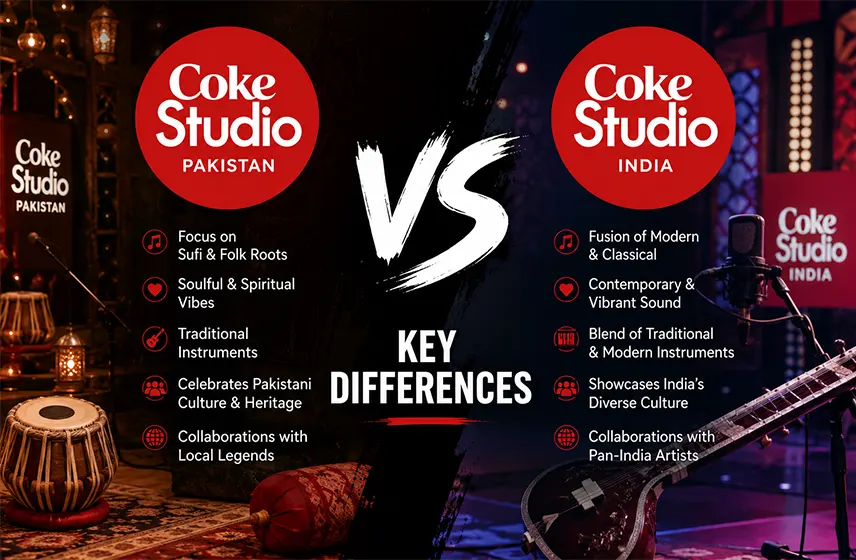
Let’s be real. If you have ever fallen down a 3 AM YouTube rabbit hole and somehow ended up crying over Tera Woh Pyar, you already know that Coke Studio hits differently. But what exactly makes it different from its Indian counterpart? And does ‘different’ automatically mean better?
Both shows carry the same red logo. Both record artists in the studio. Both promise the magic of fusion. Yet anyone who has been listening to each will tell you: these are two completely different musical worlds, shaped by geography, history, and soul.
Origin of Coke Studio Pakistan and India
Pakistan launched Coke Studio in 2008. It was created by Nadeem Zaman (Head of Marketing of Coca-Cola) and musician Rohail Hyatt, who is also a former member of the band Vital Signs. The concept of Coke Studio originated in Brazil in 2007 as Estudio Coke Studio. But it was Pakistan that turned it into a cultural religion. India followed in 2011 with Coke Studio @ MTV, inspired directly by Pakistan’s runaway success (Source: Wikipedia).
|
I still remember the first time I heard Pasoori. I was cooking dinner, and the song was playing on a Bluetooth speaker. Then Ali Seethi’s chorus came, and honestly, it was something else. Something magical that instills you that forced me to come out of the kitchen. I stood there, spoon in hand, completely still - the daal burning quietly on the stove. That’s the Coke Studio Pakistan effect. It does not ask for your attention. It takes it. |
Two Sounds, Two Histories
Coke Studio Pakistan: Where Sufism Meets the Studio
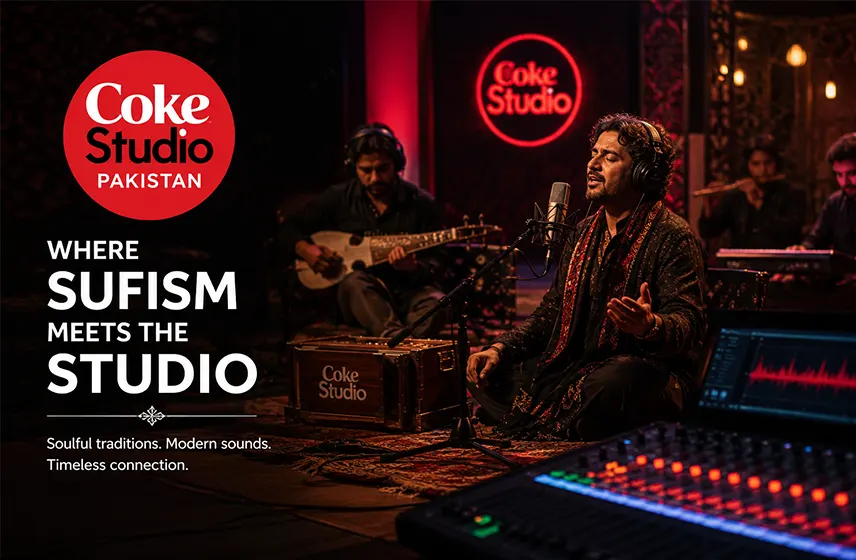
Pakistan's music has always had an ancient touch to it. Sufi poetry, qawwali, the folk traditions from across the province were not only the inspirations behind Coke Studio, were base of it.
Rohail Hyatt acknowledged this and built the show with a different idea: a qawwali can go electric without losing its essence.
Two personalities I keep coming back to are Abida Parveen and Nusrat Fateh Ali Khan. Their music belongs to no single era. Every new generation discovers it and gets completely lost in it.
There is a Coke Studio memory that I keep coming back to. It was the first time that I heard Chaap Tilak by Abida Parveen Sahiba and Rahat Fateh Ali Khan. I was in a moving car with my husband. It was late evening and the city lights were cluttered. When Abida Parveen's voice came in with that low opening that was almost breathtaking, I told my husband to quickly pull over. I couldn't listen to it in the moving car. It was the kind of music that you just have to stop everything you are doing to listen to it. This was that music. I sat in a parked car on the side of the road for the whole six minutes and let it wash over me. And I was not embarrassed about it at all.
Sorry, I just completely got lost in that memory for a moment. It just makes me so happy. Okay so coming back to what I was telling you guys.
Coke Studio India: Bollywood Domination
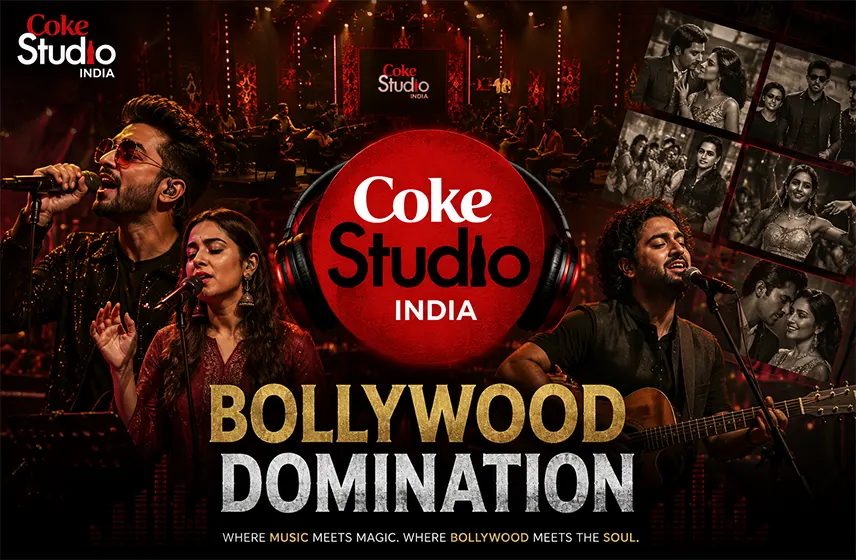
India’s edition began in 2011 on MTV India and brought a different vibe. India is widely known for its Bollywood music. Coke Studio @ MTV had to try and work in that context. We have been seeing this for years that Bollywood has always dominated the music industry in India. In addition, it has reflected on the nation’s music. (Source: Music Ally, 2024).
Coke Studio India has given us wonderful music pieces. We cannot forget the A.R Rahman season 3 episode. He created one of the exceptional pieces (Zariya) featuring Farah Siraj and Ani Choying Drolma. This was really something.
Moreover, the industry had never really seen Punjabi Gurbani and Harshdeep Kaur’s performances via mainstream platforms before. Indian Coke Studio proved to be a real game-changer when it was not dominated by Bollywood music.
India screened 4 seasons on MTV before relaunching Coke Studio Bharat in 2023. On the other hand, Pakistan has produced 15 seasons and counting.
The Instruments Tell a Story
Both studios blend traditional and Western instruments. However, their emphasis differs.
|
Pakistan’s Dominant Instruments |
India’s Dominant Instruments |
|
|
|
|
|
|
|
|
|
|
|
|
|
|
|
|
India’s sound has more music to it. Pakistan’s sets feel like they were recorded with candlelight and incense in the room, closer to what you hear at a premium music production near me studio in Karachi, where layering and clarity are the non-negotiable standards.
Viral Hits of Coke Studio
Numbers are one thing (yes they are important). But some songs earn their statistics the hard way. They stop people mid-sentence, mid-commute, mid-life. Here are the ones that actually did it:
Pasoori
This is it! The Punjabi folk-pop with reggaeton track that made Coke Studio a global name. Pasoori was the first Pakistani song to make it to the “Viral 50 Global” list. Additionally, it became the most-streamed Pakistani song in 2022 and the 2nd most searched song globally that year on Google. The unexpected? Pasoori was featured in Ms. Marvel!!!
This song introduced Shae Gill to the world. A singer who had only been posting public covers on Instagram three years prior. It introduced Shae Gill to the world, a singer who had been posting covers on Instagram just three years before. Well, this clearly shows that Pakistani singers are genuinely dominating YouTube and Spotify.
What I love about Pasoori is the part where Ali Sethi begins. In the first fifteen seconds, I was like, " Okay, not bad.” But after listening to it once, I WAS OBSESSED. And it was the only song I listened to for an entire week!
This song makes you feel like you have been waiting for it your whole life and did not know it. You might not believe but I have sent it to at least a dozen people with a message “just trust me” and none of them came back disappointed.
Afreen Afreen
Afreen Afreen launched Momina Mustehsan’s career by featuring legend Ustad Rahat Fateh Ali Khan. This version of Afreen Afreen transported everyone who appreciated the legacy of NFAK through Rahat’s imaginative yet smooth performance of this track. This song remains one of the most viewed tracks. It has over 650 million views on YouTube and is still widely appreciated across many platforms.
I remember watching this video for the first time, and thinking: how can a voice do that? This is not singing. This is Rahat breathing Afreen Afreen. You can feel the shift all around the room.
If you haven’t listened to Afreen Afreen with headphones, I can say with confidence that you haven’t really listened to it.
Ik Onkar
If there is one track that shows Indian Coke Studio can be just as good. This is it. Harshdeep Kaur’s version of this piece of the Sikh opening prayer is just so powerful. It is by far the most powerful thing to come out of either version of this show.
I was introduced to this song through a friend. He is really picky with music. So when he suggested this to me, I knew it is definitely something big.
I sensed spirituality in this song that does not come from the production or volume. But from a voice that sounds ancient. Yes it is the magic of Harshdeep Kaur. This is Indian Coke Studio at its best.
Who’s Winning the World?
Here is where things get genuinely looped. Coke Studio Pakistan is not just leading. It is clearly dominating. Music Ally in 2024 noted that Pasoori is among the top ten most-streamed tracks on Spotify in India since 2019. Can you imagine that? A Pakistani song is outperforming Indian music among Indians. It happened without a film to promote it or a Bollywood actor’s name attached. Just the music.
Season 15 “Blockbuster” by Faris Shafi was released in May 2024. It had over half a million Instagram reels and charted on Spotify’s Daily Viral Songs in India. This is the proof that Pakistan’s peak music did not take a pause with Pasoori.
In January 2024, Warner Music Group signed an exclusive global distribution deal for Coke Studio Pakistan season 15. This is a major label move that no version of Indian Coke Studio has matched.
Conclusion
It’s not a competition when talking about Pakistani and Indian Coke Studio. Sufism inspired musical storytelling of one, while the other experimented with creativity on a global level.
At the end of the day, both Coke Studios gave life to the South Asian independent music scene. With all the elements combined, independent projects can be done without the support of a cinematic Bollywood production.